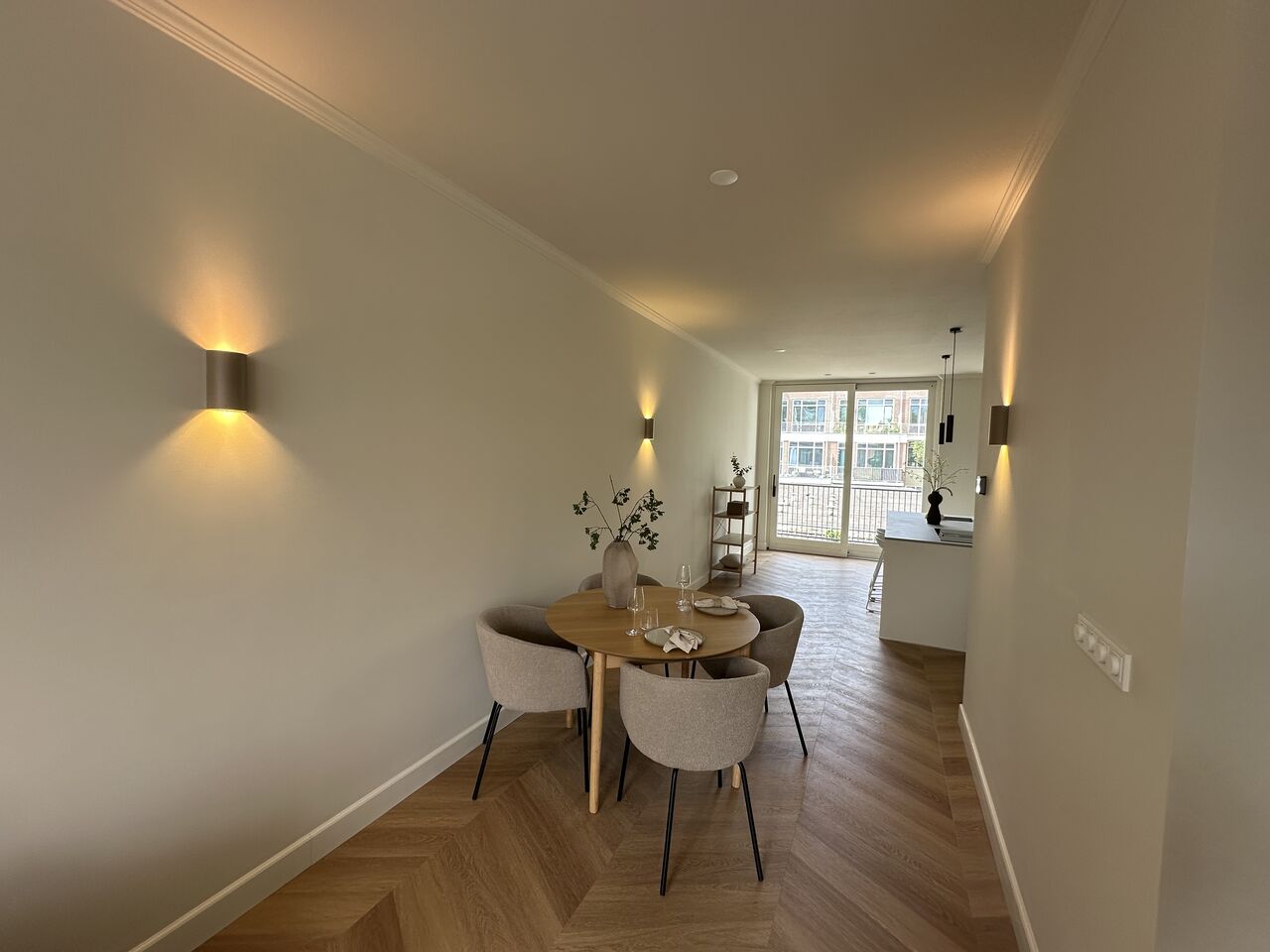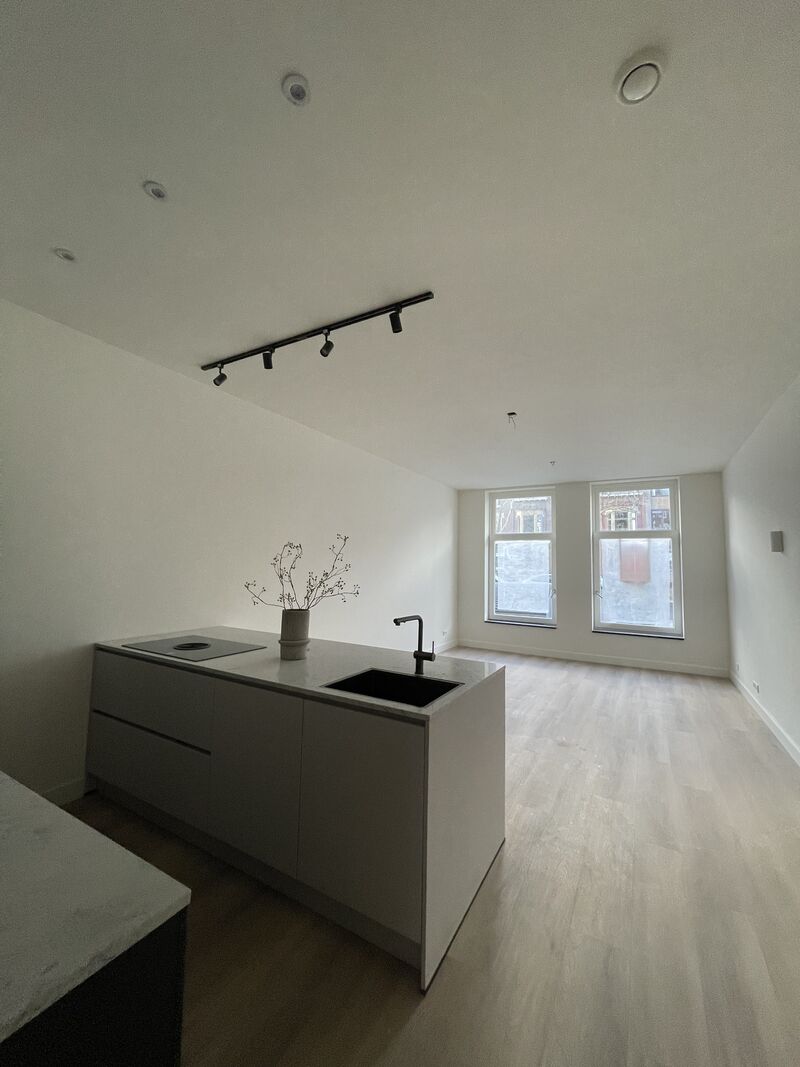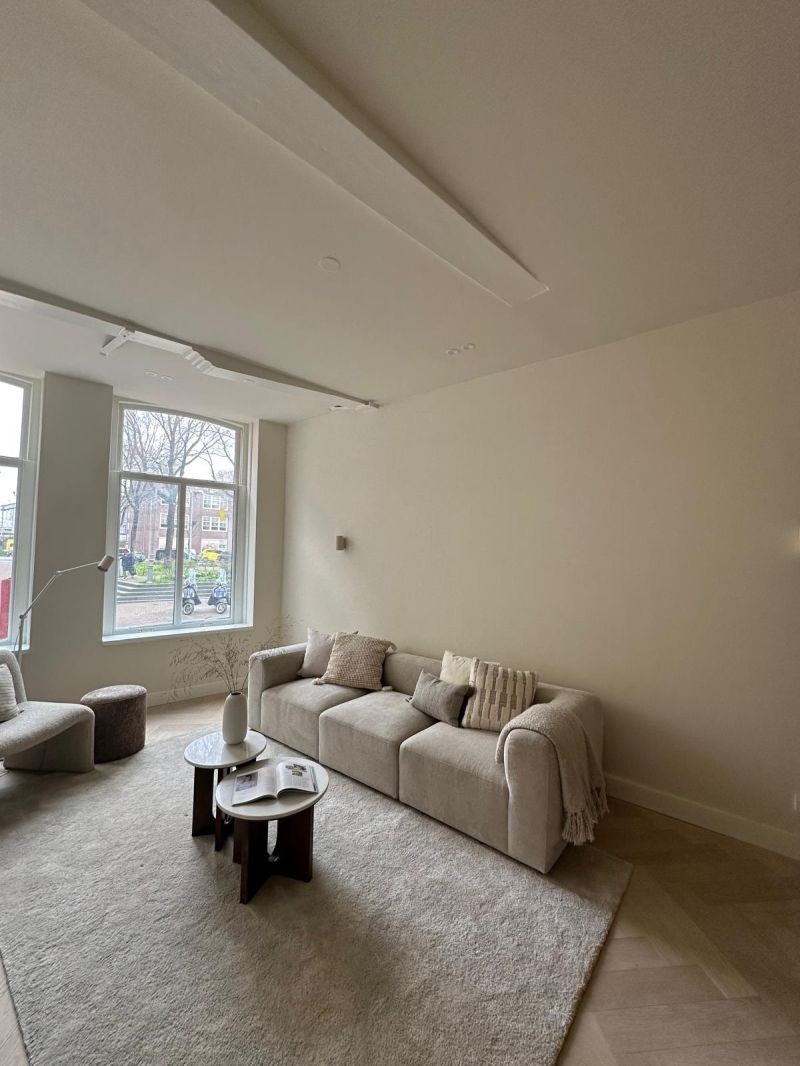
Amsterdam city centre
Smoothly finished living room
Walls and ceiling plastered completely smooth and handed over paint-ready during a full renovation.
Rotterdamse Bouwbedrijf takes care of the complete wall and ceiling finishing during renovations and refurbishments. From plastering walls and ceilings smooth or paint-ready to lining paper, decorative plaster and repair work, finished sleekly by one dedicated team of craftsmen.
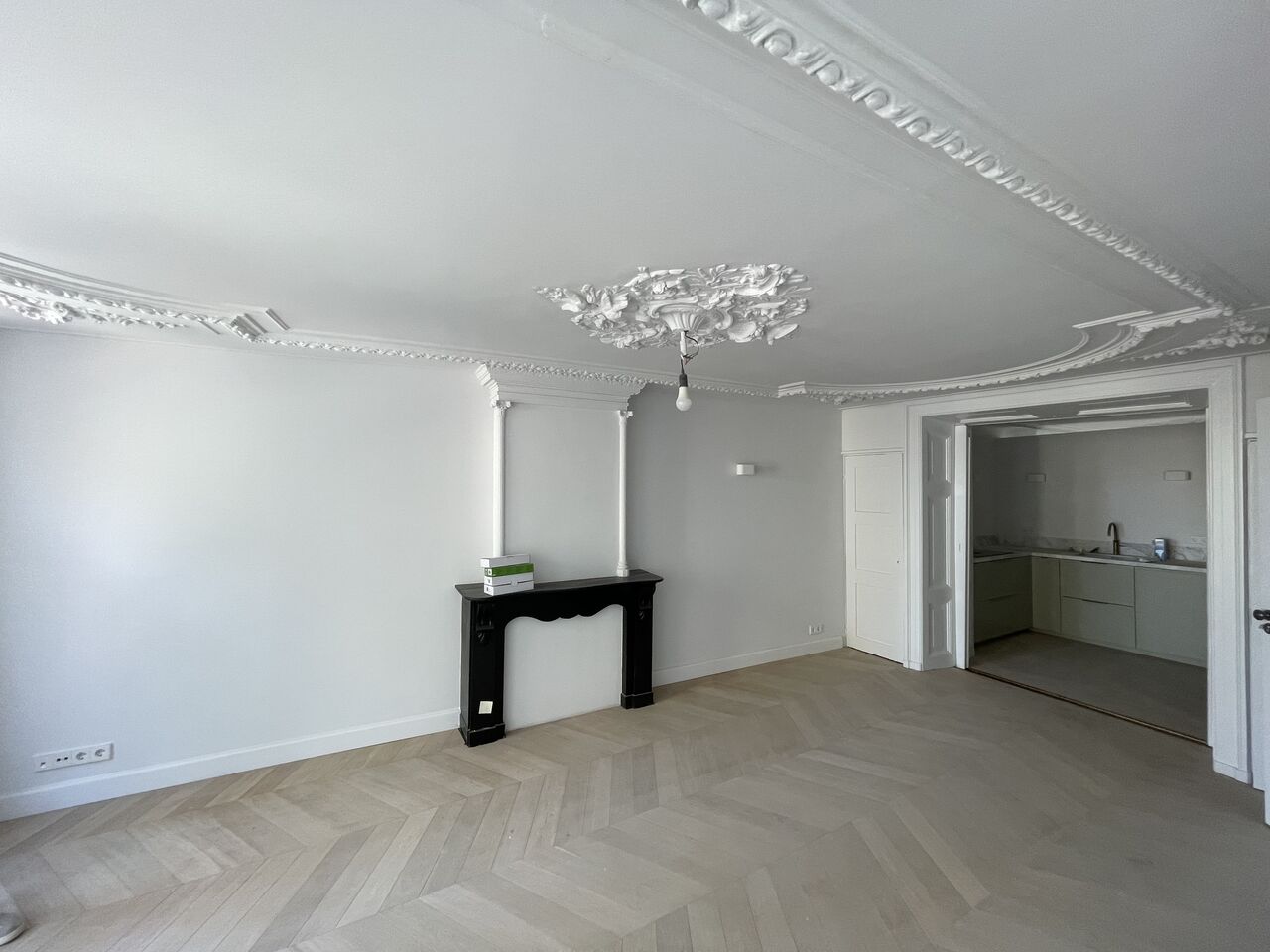
A smooth wall is only as good as the preparation beneath it. We take the time to repair, level and create the right substrate, so the plaster stays sleek and does not crack.
Our own plasterers, not a rotating cast of subcontractors. The same people, the same standard, even on larger projects.
The plastering ties in seamlessly with the services, window frames and finishing, because we keep the whole project in our own hands.
You know where you stand from the outset. No surprises afterwards, and you get a one-year guarantee on our work.
From sleek smooth plastering to decorative stucco. We advise on what suits each room best.
A sleek, smooth coat of plaster on walls and ceilings, paint-ready straight away. The most popular finish for living spaces.
New or existing walls finished sleekly, from levelling and repairs to an even, paint-ready wall.
Even, seamless ceilings with no cracks or old tiles, finished smooth and ready to paint.
Decorative textured plaster (spachtelputz): hard-wearing, characterful and low-maintenance, ideal where you want texture.
The substrate prepared for lining paper or glass-fibre lining. Bridges hairline cracks and gives an even, paintable wall.
Finished so sleekly that, once dry, you can paint straight over it with no further preparation.
Fast, even spray work for ceilings and walls. A seamless result, ideal for larger surfaces.
A seamless, hard-wearing, moisture-resistant cement finish for walls, floors and bathrooms, with a sleek, industrial look.
To bathroom renovationRepairing and levelling cracks, holes, damage and uneven walls as the basis for a sleek final result.
Walls and ceiling plastered completely smooth and handed over paint-ready during a full renovation.
Every room plastered sleekly after repairing the substrate, ready for painting.
A whole apartment given smooth, paint-ready plastering as part of the renovation.
We are continually gathering more before-and-after photos and close-ups of sleek plastering. Feel free to ask for references in your area.
We assess the substrate and the room and advise on the best finish: smooth, lining paper or decorative plaster.
Masking off, repairing the substrate, levelling and applying the right primer or reinforcement.
Applying plaster to walls and ceilings sleekly in the right coats, smooth or in the texture you want.
We give the plaster time to dry out evenly and fully before it is finished.
Checking over, touching up small points and handing over neatly, paint-ready.
Tell us briefly about your home and your plans. You get a free quote, usually within one working day, with no obligation.
Craftsmanship by our own team, no subcontractors.
A clear quote, no surprises afterwards.
On the plastering we carry out.
Smooth, textured or as a base for wallpaper: for each finish, what it is and when to choose it.
A sleek, even wall that can be painted straight away. The most popular finish in a modern interior.
Flat enough for wallpaper or glass-fibre lining. Small irregularities disappear behind the paper.
Making a textured (spachtelputz) wall smooth again, usually without scraping it off, after a bonding agent.
A deliberate texture or look, such as a concrete look or lime plaster. Beautiful as a feature wall or in a characterful interior.
A ceiling plastered smooth or spray-finished. For a new plasterboard ceiling we choose the finish with you.
On a wall with many cracks or an uneven substrate, glass-fibre lining gives a sleek base, or we first repair with mesh.
The substrate differs per building period. This is what we see most in the Randstad.
Old lime plasters and mouldings. We first repair the existing plaster and use materials that suit it.
Lots of textured plaster and spray finish. Plastering over it to a smooth wall is the most requested job here.
Plasterboard and sand-lime brick that can be finished paint-ready straight away.
New walls, concealed pipes and new frames need sleek plastering as the last step before painting.
Plastering is only as good as the preparation. This is what we see most, and how we prevent it.
Plastering over a loose or dusty substrate, so it comes off.
We clean and consolidate the substrate and apply a bonding agent.
Not repairing cracks, so they come back.
We repair cracks first, with mesh or lining where needed.
Painting too soon, causing stains and poor adhesion.
We advise on drying time and only paint when the wall is dry throughout.
Poor masking, leaving marks on floors and frames.
We carefully mask floors, frames and sockets.
Promising paint-ready on a substrate that can't deliver it.
We assess the substrate in advance and say honestly what is achievable.
Rotterdamse Bouwbedrijf is at home in Rotterdam, but we plaster and finish across the whole Randstad. From Schiedam, Vlaardingen, Ridderkerk and Spijkenisse to Rijswijk, Voorburg, Zoetermeer, Gouda, Leiden and Amsterdam: nineteen towns with a page of their own, and everywhere in between. Don't see your town listed? Do get in touch.
And also in, among others
New walls and ceilings, ready for plastering.
Plastering as part of a full renovation.
Interior finishing of the new dormer.
Sleek walls in the new space.
The trades in a Dutch renovation.
A survey at your home and a clear price up front.
Living in Rotterdam or the Randstad and looking to have your home plastered or finished? Request a free, no-obligation quote from Rotterdamse Bouwbedrijf.
Guide prices including VAT for Rotterdam and the Randstad in 2026 per square metre of wall or ceiling. Including preparation and the plastering itself; masking, repairs and painting are options.
Walls and ceilings sleek and even, ready to paint.
Also on old or textured walls, with a bonding agent.
Concrete look, lime plaster or another deliberate texture.
About eighty square metres of wall and ceiling, paint-ready or smooth.
| Paint-ready | Smooth / over texture | Decorative | |
|---|---|---|---|
| Drying time before painting | A few days to a week | A few days to a week | Depends on the product |
| Substrate | Flat and sound | Also textured, after bonding agent | Flat and sound |
| Suitable for ceilings | Yes | Yes | Sometimes |
The background below will help you make the right choices when having your home plastered. No sales pitch, just the practical considerations.
In living rooms and bedrooms people usually choose smooth plastering (gypsum-based), because it is sleek, timeless and paint-ready straight away. In wet rooms such as the bathroom and cellar, you work with cement-based plaster or a water-resistant finish. Where you want texture or extra robustness, decorative plaster is a good choice, and on crack-prone walls lining paper is the answer.
Paint-ready plastering is finished so smooth that you can paint straight over it. Wallpaper-ready or lining-paper ready is slightly less fine, because wall covering still goes over it to absorb small imperfections. If you want sleek, smooth walls without wallpaper, choose paint-ready; if lining paper or wallpaper is going on anyway, wallpaper-ready saves you money.
Almost always. Loose old plaster, cracks, holes and uneven walls must first be repaired and levelled. Plastering over a poor substrate causes problems sooner or later: it fails to bond, cracks or comes away. A good plasterer spends more time on the preparation than on the plastering itself.
Cracks come from movement in the substrate (settlement, temperature, vibration), from plastering onto a non-bonding or overly smooth surface, or because joints and material transitions have not been reinforced. At vulnerable points, such as junctions between different materials, we therefore apply reinforcing mesh and use the correct primer.
Every substrate calls for its own approach. Smooth, absorbent or non-absorbent surfaces get a suitable primer so the plaster bonds well and dries evenly. Concrete, gypsum blocks, sand-lime brick and old plaster all behave differently. Assessing the substrate is therefore the first step.
Fresh plaster must dry out fully before it is painted, roughly one to two weeks per coat, depending on the thickness of the layer, ventilation and temperature. As it dries, the colour shifts from dark to an even, light tone. Finishing too early leads to blistering paint or staining. We factor this into a tight renovation schedule.
Gypsum-based plaster finishes finely and dries relatively quickly; ideal for dry interior rooms. Cement-based plaster is stronger and moisture-resistant and is used in bathrooms, cellars and on external walls. The choice depends on the room, the load and the moisture conditions.
In a bathroom, plaster can look beautiful, but only with moisture-resistant materials and a sound build-up. Microcement is popular for a seamless, water-resistant wall or floor with no joints. We coordinate this within the complete bathroom renovation, including the correct corner sealing and ventilation.
Plastering is usually one of the last steps before finishing. During a full home renovation the services are tucked away and the substrate is sound, so the plaster can be applied sleekly in one go. This avoids having to chase out or touch up again later.
On old, crack-prone walls, lining paper is often smarter than plastering fully smooth. The glass-fibre lining bridges hairline cracks, gives an even, paintable wall and is more economical. For a completely smooth, texture-free result, however, smooth plastering remains the best choice.
Decorative plaster (spachtelputz) suits places where you want a lively texture, robustness and easy maintenance, such as a hallway or stairwell. It hides imperfections and is less prone to damage than sleek, smooth plastering.
Want to know more about the related work? Take a look at kitchen renovation, bathroom renovation, window frames and insulation, home extensions, roof extension or dormer installation. You can also view our projects or get in touch.